
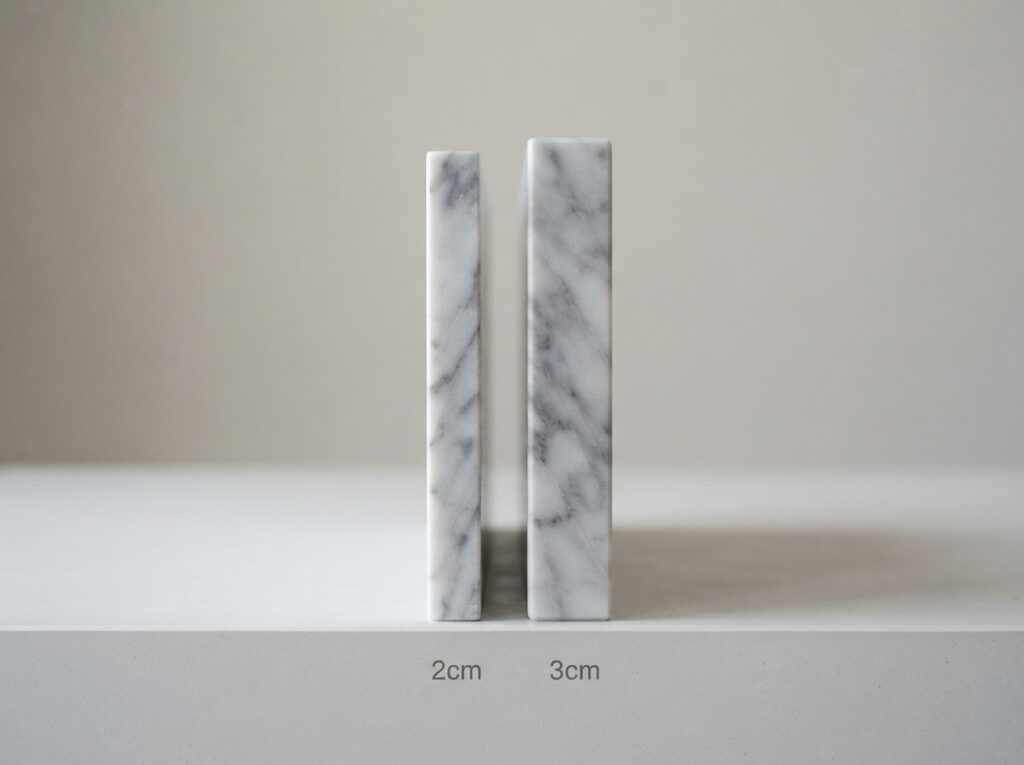
Kitchen countertop slab thickness is one of those details that homeowners may overlook until they begin comparing stone materials for their remodeling project. While color, veining, and surface finish usually receive the most attention, the thickness of a slab can influence its appearance, weight, edge design, and support requirements.
Two common thicknesses for natural stone and engineered quartz countertops are 2cm and 3cm. Both can be suitable for kitchen projects, but they offer different advantages depending on the selected material, countertop layout, and design specifications.
At Arena Marble & Granite in Thousand Oaks, CA, we help homeowners explore premium stone slabs and custom fabrication options for kitchen countertop remodeling. Understanding slab thickness before choosing your material can help you make a more informed decision.
Kitchen Countertop Slab Thickness: Understanding 2cm vs. 3cm
Stone slab thickness is generally measured in centimeters or millimeters. For many granite, quartzite, and engineered quartz products, 2cm and 3cm are common options.
However, actual availability and dimensional tolerances vary by manufacturer, material, and slab collection.
What Is a 2cm Countertop Slab?
A 2cm slab measures approximately 20 millimeters, or 0.79 inches, thick. It offers a relatively slim profile that can complement contemporary kitchen designs.
Because it contains less material than an equivalent 3cm slab, a 2cm slab is generally lighter when both slabs have the same composition and dimensions.
Homeowners may consider 2cm materials for projects where a thinner appearance is preferred or where specific fabrication methods allow a customized edge design.
However, thinner slabs may require additional structural support depending on the material, countertop dimensions, sink cutouts, and overhangs. Those requirements must be evaluated by qualified professionals.
What Is a 3cm Countertop Slab?
A 3cm slab measures approximately 30 millimeters, or 1.18 inches, thick. This provides a more substantial edge appearance and greater material thickness compared with a 2cm slab of the same composition.
Many homeowners appreciate the visual weight of thicker stone, especially on kitchen islands and expansive countertops.
Depending on the material and design, 3cm slabs may offer greater flexibility for certain edge profiles and countertop configurations.
However, a thicker slab does not automatically eliminate the need for structural support. Cabinet construction, unsupported spans, cutouts, and manufacturer specifications must still be considered.
Quick Comparison: 2cm vs. 3cm
| Feature | 2cm Slabs | 3cm Slabs |
|---|---|---|
| Approximate thickness | 20mm | 30mm |
| Visual appearance | Slimmer profile | More substantial profile |
| Relative weight | Generally lighter | Generally heavier |
| Edge design | Depends on fabrication and material | May accommodate more profile options |
| Support requirements | Project-specific; may need additional support | Project-specific; support may still be needed |
| Best consideration | Streamlined aesthetics | Thicker visual appearance |
These comparisons are general. The appropriate specifications depend on the actual stone product and the requirements of your project.
How Slab Thickness Influences Kitchen Countertop Design
The right thickness affects more than the countertop’s side profile. It can influence design decisions that should be addressed before fabrication begins.
Countertop Edges and Visual Thickness
One of the most noticeable differences between 2cm and 3cm countertops is the exposed edge.
A 3cm slab naturally creates a thicker appearance, while a 2cm slab offers a slimmer look. Depending on the stone and fabrication specifications, a laminated or mitered edge may create the appearance of additional thickness.
Common edge options include eased, beveled, and bullnose profiles. However, not every edge is suitable for every slab.
Porcelain and certain engineered products may have specific manufacturing limitations that affect the available edge treatments.
Kitchen Islands and Overhangs
Large kitchen islands often require special attention to countertop dimensions, unsupported sections, and seating overhangs.
A thicker slab can influence structural performance, but material thickness alone does not determine whether an overhang is adequately supported.
The stone’s properties, cabinet structure, layout, and manufacturer requirements all matter.
Homeowners should have the support requirements evaluated by the qualified professionals responsible for their project before finalizing countertop specifications.
Sink and Cooktop Cutouts
Sink openings and cooktop cutouts create areas that require careful fabrication planning.
Slab thickness can affect the available edge details and material surrounding these openings.
Accurate specifications are important, particularly when the countertop design includes narrow sections of stone or multiple cutouts.
At Arena Marble & Granite, we help customers review countertop dimensions and explore custom stone fabrication options within our scope of services.
Waterfall Kitchen Islands
A waterfall countertop continues the stone surface vertically along the side of an island or cabinet.
This design requires careful planning of slab dimensions, edge details, and pattern continuity. For naturally veined materials, the placement of each section can influence the finished appearance.
Thickness also affects how the edge transition looks and which fabrication details may be appropriate.
Discussing these considerations before selecting the slab can help homeowners choose materials suited to their desired design.
Choosing Slab Thickness for Different Kitchen Countertop Materials
Not every material is available in the same thicknesses. At Arena Marble & Granite, our primary kitchen countertop materials include granite, quartzite, quartz, soapstone, and porcelain.
Granite and Quartzite
Granite and quartzite are natural stones appreciated for durability and distinctive patterns.
Depending on the product and supplier, both may be available in 2cm or 3cm formats.
For a kitchen with substantial stone edges, a thicker slab may create the desired appearance. For a more streamlined design, a thinner option may be worth exploring when suitable support and fabrication specifications are available.
Natural stone characteristics vary between slabs, so thickness should be considered alongside porosity, veining, finish, and intended use.
Explore our granite countertops and quartzite countertop materials for additional information.
Engineered Quartz
Engineered quartz is known for consistent patterns, stain resistance, and straightforward maintenance.
Many quartz manufacturers offer products in 2cm and 3cm thicknesses, although available options vary by collection.
When comparing engineered quartz, review the manufacturer’s approved fabrication methods, edge profiles, and support requirements.
Remember that quartz contains resins and can be damaged by excessive heat. Countertop thickness does not eliminate the need for trivets and appropriate care.
Learn more about quartz countertop options.
Porcelain and Soapstone
Porcelain slabs often come in thicknesses that differ from the traditional 2cm and 3cm formats. Depending on the manufacturer, porcelain products may be offered in measurements such as 6mm, 12mm, or 20mm.
Not every thickness is suitable for kitchen countertop applications. Product-specific fabrication requirements and intended uses must be verified.
Soapstone is another natural material with distinctive characteristics. Its available thicknesses depend on the supplier and slab selection.
Because soapstone is softer than granite and quartzite, its edge design and fabrication requirements deserve careful consideration.
Discover our porcelain slabs and soapstone countertops for more material information.
Planning Your Countertop Project in Thousand Oaks
Selecting the right countertop thickness begins with understanding your kitchen layout, design preferences, and the characteristics of your chosen material.
At Arena Marble & Granite, we specialize in kitchen countertop remodeling, premium stone slabs, and custom fabrication for slab-based improvements.
Our team can help you compare available materials, discuss countertop dimensions, review edge profiles, and explore suitable fabrication options.
We do not provide countertop installation, complete kitchen renovations, cabinetry, plumbing, or electrical work. These activities must be handled by qualified professionals.
We also sell floor and wall tiles without providing tile installation.
Visit our Thousand Oaks showroom to explore available stone slabs and discuss your project requirements. Our service areas include Westlake Village, Newbury Park, Oak Park, Camarillo, and surrounding communities.
Frequently Asked Questions About Kitchen Countertop Slab Thickness
Is 3cm better than 2cm for kitchen countertops?
Not necessarily. A 3cm slab offers a thicker appearance and different structural characteristics, but both thicknesses may be suitable depending on the material, countertop design, and support requirements. The best choice depends on project specifications rather than thickness alone.
Does a thicker countertop always last longer?
No. Countertop performance depends on the material, fabrication quality, structural support, everyday use, and maintenance. A thicker slab does not automatically guarantee longer service life.
Can a 2cm countertop look thicker?
Yes. Depending on the material and fabrication requirements, techniques such as laminated or mitered edges can create the appearance of a thicker countertop. These options are not available for every slab and must be reviewed individually.
Do all stone materials come in 2cm and 3cm?
No. Thickness availability varies by material, manufacturer, and product collection. Porcelain, for example, is often manufactured in different thicknesses than natural granite or engineered quartz.
Does slab thickness affect kitchen island design?
Yes. Slab thickness can influence visual proportions, weight, edge details, and support considerations. Kitchen island dimensions, cutouts, and overhangs should be evaluated before choosing a final countertop specification.
Can Arena Marble & Granite help me compare slab thicknesses?
Yes. Our team helps homeowners explore available stone materials, slab dimensions, edge profiles, and custom fabrication options. We focus on countertop remodeling and slab-based stonework without providing installation services.
Visit Arena Marble & Granite in Thousand Oaks, CA
Choosing the right kitchen countertop slab thickness is easier when you can compare actual materials and discuss your design requirements with knowledgeable professionals.
Whether you’re considering granite, quartzite, quartz, soapstone, or porcelain, Arena Marble & Granite can help you explore available slab options for your kitchen countertop project.
Arena Marble & Granite
2300 Corporate Center Drive
Thousand Oaks, CA 91320
Phone: (805) 375-2771
Website: https://arenamarble.com/
Find our showroom on Google Maps.
Ready to compare countertop materials? Contact Arena Marble & Granite to request a free estimate or visit our Thousand Oaks showroom to explore the stone slabs available for your project.