
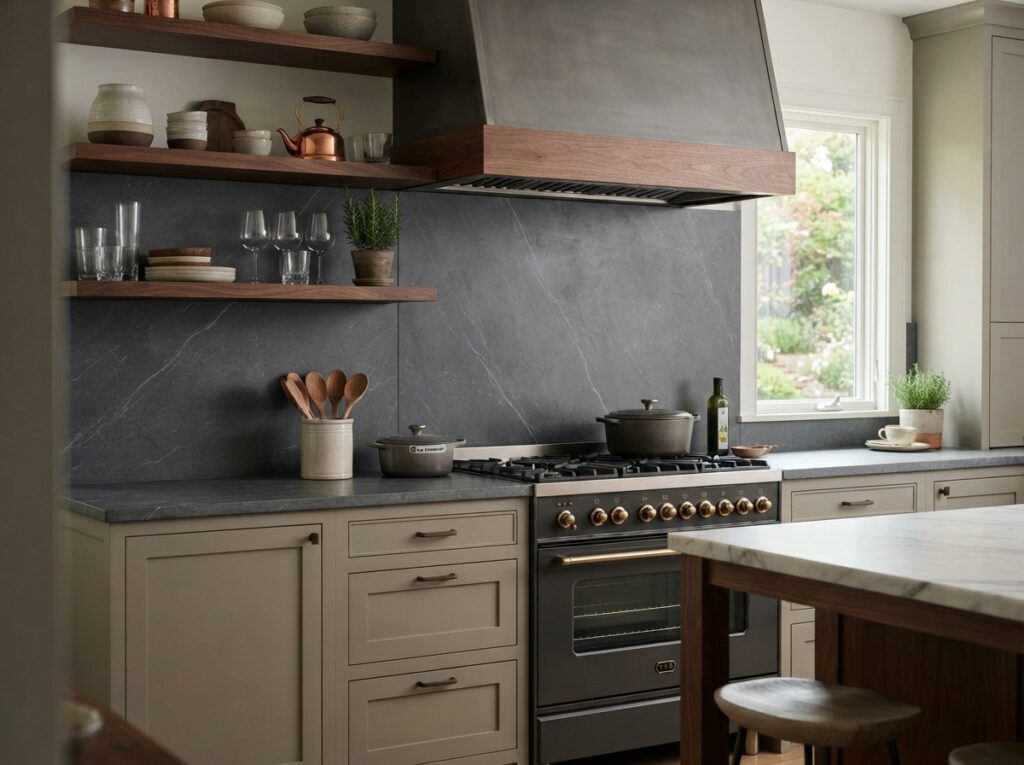
Soapstone isn’t the material most people think of first when planning a backsplash, but it’s quickly becoming one of my favorite recommendations for homeowners who want something understated instead of flashy. Soapstone backsplash slabs bring a soft, matte texture to a kitchen that pairs beautifully with almost any countertop material, especially when you want the backsplash to feel like a quiet complement rather than the main event.
What Makes Soapstone Different for a Backsplash
Soapstone is a natural stone made primarily of talc, giving it a smooth, almost soft-to-the-touch surface with a muted gray or green-gray tone. Unlike granite or quartzite, it doesn’t have dramatic veining or high shine — its beauty comes from its simplicity and the way it subtly darkens and develops character over time.
As a slab rather than tile, a soapstone backsplash also eliminates grout lines, giving your kitchen wall a clean, continuous surface that’s easy to keep clean behind a stove or sink.
Why Homeowners Choose Soapstone for a Backsplash
- Non-porous and low maintenance — no sealing required, ever
- Naturally resistant to bacteria and moisture — a genuine plus behind a sink or stove
- Heat resistant — handles proximity to a range or cooktop without concern
- Understated, timeless look — pairs well with farmhouse, traditional, and minimalist kitchens alike
Soapstone is softer than granite, so it can pick up light scratches over time. Many homeowners actually like this, since it’s part of the natural patina the material develops, but it’s worth knowing going in if you prefer a surface that looks identical years down the road.
How the Process Works
When you visit our Thousand Oaks showroom, we’ll walk you through our current soapstone inventory so you can see the actual slab, its texture, and its color in person. From there, our team handles precise measuring, fabrication, and installation to fit your kitchen’s specific dimensions.
Our backsplash services page covers more about our process and the range of materials we offer. As always, I want to be clear about scope: we handle backsplash slab selection, fabrication, and installation. We sell tile as well, but tile installation itself isn’t something we provide directly.
Soapstone Compared to Other Backsplash Materials
If soapstone’s muted look isn’t quite what you’re picturing, it’s worth comparing it to quartzite or granite backsplash slabs, both of which bring more dramatic veining and pattern into the space. Soapstone tends to appeal most to homeowners who want their countertop material, rather than the backsplash, to be the visual focal point of the kitchen.
We work with homeowners throughout Thousand Oaks, Agoura Hills, and Camarillo who pair soapstone backsplashes with granite or quartzite countertops for a cohesive, natural stone kitchen without every surface competing for attention.
Frequently Asked Questions
Do soapstone backsplash slabs need to be sealed?
No sealing is required. Some homeowners apply mineral oil periodically to enhance the natural darkening process, but this is optional rather than necessary for protection.
Will a soapstone backsplash scratch easily?
Soapstone is softer than granite or quartzite, so light scratching can happen over time. Many homeowners consider this part of its natural character rather than a flaw.
Does soapstone match well with other stone countertops?
Yes, its muted tone pairs well with almost any countertop material, making it a flexible choice whether your counters are bold and veined or more neutral.
How do I clean a soapstone backsplash?
Warm water and mild soap handle daily cleaning easily. Harsh chemical cleaners aren’t necessary and can be avoided.
Come See Our Soapstone Selection
If soapstone backsplash slabs sound like the right fit for your kitchen, stop by our showroom at 2300 Corporate Center Drive in Thousand Oaks to see our current inventory. You can find us on Google Maps for directions and hours — I’d love to help you find the right piece for your space.