
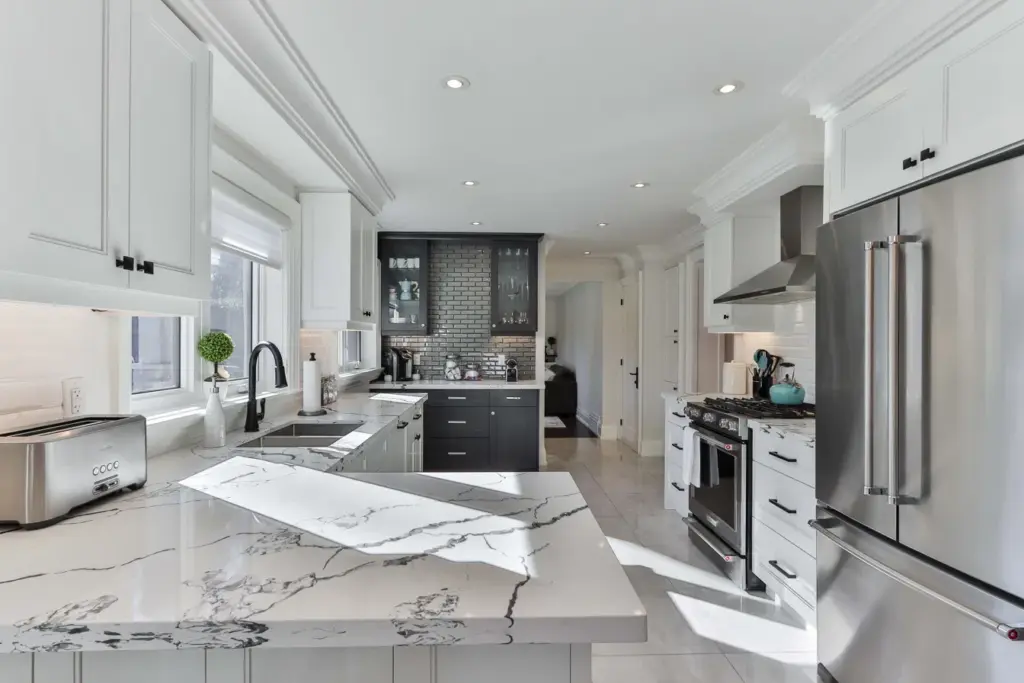
If you are planning a kitchen countertop remodel, the hardest part is rarely deciding to do it. The hard part is choosing between materials that all look great in photos and all have loyal fans. After more than 10 years of helping homeowners across Thousand Oaks and the Conejo Valley pick slabs, I have learned that the best choice almost never comes down to which stone is “best.” It comes down to how you actually use your kitchen.
So this guide is not a sales pitch for one material. I will walk you through the five we work with most, tell you what each one does well, tell you what to watch out for, and then help you match them to your daily routine.
The Short Answer
If you only have a minute, here is how most of our conversations end up:
- You cook a lot and love natural patterns: granite
- You want low maintenance and a consistent look: quartz
- You love the look of marble but want more durability: quartzite
- You want the toughest, easiest surface, indoors or out: porcelain
- You want a soft, matte, classic feel: soapstone
Keep reading if you want the reasoning, the tradeoffs, and the details that rarely make it into a product brochure.
Three Questions to Ask Before You Choose
Before we even look at slabs, I ask homeowners three things. Your answers narrow the field quickly.
1. How hard is your kitchen on its surfaces?
A household that cooks every night, has kids doing homework at the island, and entertains on weekends puts far more wear on a countertop than a kitchen used a few times a week. Heavy use pushes you toward the most durable options.
2. How much upkeep are you willing to do?
Some stones ask for a little sealing once in a while. Others ask for nothing. Neither is wrong, but you should choose with your eyes open.
3. Do you want natural variation or a predictable pattern?
Natural stone gives you a slab that no one else has. Engineered materials give you consistency. Some people love the first, some strongly prefer the second.
If you want to see how these decisions fit into the full project, our kitchen countertop remodel page explains each step from selection to installation.
Granite: The Dependable Natural Stone
Granite is cut from natural stone, which means every slab is one of a kind. It handles heat well, resists scratches, and has been a trusted choice for kitchens for decades. If you want a surface that looks like it belongs to your home and nobody else’s, granite delivers that.
What homeowners like
- Excellent heat and scratch resistance for everyday cooking
- A wide range of colors, from quiet neutrals to bold movement
- Natural, one-of-a-kind patterns
What to know
- It is a natural, porous stone, so it needs periodic sealing
- Patterns vary a lot, so choose from the full slab, not a small sample
- A hard hit on an exposed edge can chip it, which good fabrication helps prevent
You can browse the full range on our granite countertops page.
Quartz: The Low-Maintenance Favorite
Quartz is engineered, made from crushed natural quartz combined with resin and pigments, then formed into slabs. That is why it looks so consistent from one end of the kitchen to the other, and why it never needs sealing. For families who want a countertop they do not have to think about, quartz is usually the first material I mention.
What homeowners like
- No sealing required, ever
- Strong stain resistance for wine, coffee, oil, and citrus
- Consistent color and pattern, which helps with large islands and long runs
What to know
- It is less heat tolerant than natural stone, so use a trivet under hot pans
- Prolonged, direct sunlight can affect some colors over time, which matters in bright, sunny kitchens
- Patterns repeat, so it will not have the one-of-a-kind movement of natural stone
Our quartz countertops page shows the colors and styles we carry.
Quartzite: Marble Looks With Real Toughness
Quartzite is a natural stone that forms when sandstone is compressed under intense heat and pressure. The result often has the soft, flowing veining people love about marble, but with much more hardness. It is a favorite for homeowners who want an elegant, light kitchen that can still handle a busy week.
What homeowners like
- Marble-like veining with far better everyday durability
- Strong resistance to heat and scratches
- Every slab is unique
What to know
- It is natural and porous, so it needs sealing
- Not every slab sold under the name quartzite behaves like true quartzite, so see and discuss the slab in person before you commit
- Premium slabs with dramatic movement are worth choosing slowly
Explore options on our quartzite countertops page.
Porcelain: The Toughest Surface We Carry
Porcelain is made by firing clay at very high temperatures, which creates a dense, non-porous surface. It resists heat, scratches, stains, and UV fading, and it never needs sealing. Today’s slabs also come in convincing marble, stone, and concrete looks, so you no longer give up style for performance.
What homeowners like
- Very high resistance to heat, scratches, and stains
- No sealing and very little upkeep
- UV stable, which makes it a smart match for kitchens that open to a patio or outdoor kitchen
What to know
- It can chip at an exposed edge if it takes a hard direct hit
- Edge options can be more limited than with thicker stone, so we talk through this early
- Fabrication is more specialized, which is another reason to work with a team that handles it regularly
See what we offer on our porcelain countertops page.
Soapstone: Soft, Matte, and Timeless
Soapstone is a natural stone with a velvety feel and a muted gray or green-gray tone. It is non-porous, it handles heat well, and it develops a richer patina over time, especially if you choose to apply mineral oil. It suits farmhouse, traditional, and understated modern kitchens beautifully.
What homeowners like
- No sealing required
- Naturally non-porous and heat tolerant
- A quiet, classic look that ages gracefully
What to know
- It is softer than granite or quartzite, so it can scratch or dent with heavy use
- Light scratches can often be sanded out, which is unusual for stone
- The color range is narrower, and it darkens over time, so decide whether you like that evolving character
Learn more on our soapstone countertops page.
Side by Side Comparison
| Material | Type | Sealing | Heat | Best for |
|---|---|---|---|---|
| Granite | Natural | Periodic | Excellent | Heavy cooking, natural patterns |
| Quartz | Engineered | Never | Use trivets | Low maintenance, consistent design |
| Quartzite | Natural | Periodic | Excellent | Marble look with durability |
| Porcelain | Manufactured | Never | Excellent | Toughest surface, indoor and outdoor |
| Soapstone | Natural | Never | Excellent | Matte, classic, lived-in look |
Whatever you choose, a trivet under very hot cookware is a good habit with any countertop.
Matching Kitchen Countertop Materials to How You Live
This is the part that usually settles the decision. Here are the situations I hear most.
You cook every day
Granite, quartzite, and porcelain handle heat and daily prep best. Pick based on whether you want natural pattern, marble-like veining, or the lowest upkeep.
You have young kids
Quartz and porcelain shrug off spills and never need sealing. Rounded edges are also worth considering for little ones.
You love the look of marble
Quartzite is usually the answer. You get that soft, flowing movement with more durability for a working kitchen.
Your kitchen opens to the patio
Porcelain is hard to beat because it stays stable in strong sunlight, which helps your indoor and outdoor surfaces match.
You want a classic, lived-in kitchen
Soapstone ages beautifully, and many homeowners enjoy that character. If you prefer a surface that looks the same in ten years, another material may suit you better.
You are choosing for resale
Granite, quartz, and quartzite are all widely recognized by buyers. Choose the one you will enjoy living with first, because that is the best way to get value from it. You can see finished kitchens in our project gallery for ideas.
Details That Change the Final Result
Material is the big decision, but a few smaller choices shape how your kitchen looks and feels.
- Edge profile: a simple eased edge feels clean and modern, while a rounded or decorative edge feels softer or more traditional.
- Seams: on larger kitchens, seam placement matters. We plan it carefully so it works with your layout and your slab pattern.
- Sink and cooktop cutouts: the type of sink you choose affects how the cutout is fabricated, so decide early.
- Backsplash: a slab backsplash can match your countertop for a seamless look, which is why many homeowners decide on both together.
For an overview of everything we offer, visit our countertops page.
How We Handle Your Kitchen Countertop Remodel
We keep the process simple, because the stone should be the exciting part.
- Consultation. We talk through your kitchen, your style, and your daily routine.
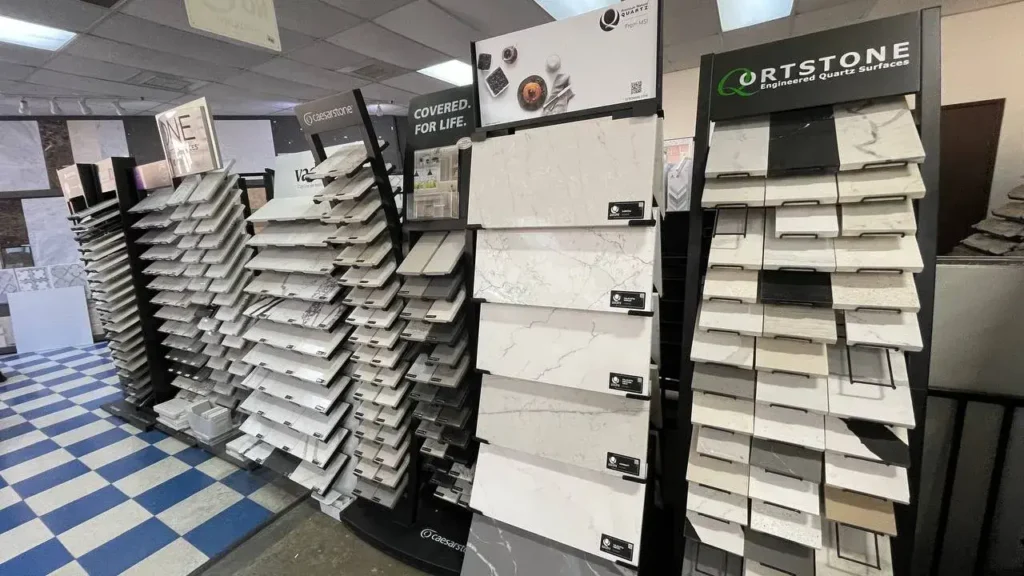
- Slab selection. You come to our Thousand Oaks showroom and see full slabs, not small samples.
- Measuring. We take precise measurements so the stone is cut to fit.
- Fabrication. Your slab is cut and finished with your chosen edge and cutouts.
- Installation. Our team installs your new countertop.
I want to be clear about what we do and do not do, because it helps you plan. We specialize in the countertop and stone surface portion of a remodel. We are not a general contractor, so cabinets, plumbing, electrical, and full kitchen renovations are handled by other professionals. We also sell floor and wall tile, but we do not install it. Homeowners across Thousand Oaks, Westlake Village, Newbury Park, Oak Park, Camarillo, and the rest of the Conejo Valley work with us this way, and you can see the full list on our service area page.
Taking Care of Your Countertop
Care depends on the material. Natural stones like granite and quartzite benefit from periodic sealing and gentle cleaners. Quartz, porcelain, and soapstone are much simpler. We walk you through the specifics for your material at installation, and our stone care page has practical guidance you can come back to anytime.
Frequently Asked Questions
Which kitchen countertop material is the most durable?
Porcelain, granite, and quartzite are all very durable, just in different ways. Porcelain resists heat, scratches, and stains, while granite and quartzite offer natural hardness and strong heat resistance.
Which material needs the least maintenance?
Quartz and porcelain never need sealing, and soapstone does not need it either. Granite and quartzite are natural and porous, so they benefit from periodic sealing.
Can I use a hot pan directly on my countertop?
Granite, quartzite, porcelain, and soapstone handle heat well, but a trivet is still a good habit. Quartz is the most sensitive to heat, so a trivet matters most there.
Is natural stone or engineered stone better?
Neither is better overall. Natural stone gives you one-of-a-kind patterns, while engineered materials give you consistency and easier care. The right one depends on your priorities.
Can I see the actual slabs before I decide?
Yes, and we encourage it. Seeing the full slab in person is the best way to judge color, veining, and finish before anything is cut.
Do you handle the whole kitchen remodel?
No. We focus on the countertop and stone surfaces. We sell tile, but we do not install it, and we do not handle cabinets, plumbing, electrical, or full renovations.
Do you work with commercial projects too?
Yes, we work on both residential and commercial countertop projects.
Ready to See the Slabs in Person?
Reading about materials only gets you so far. The real answer usually shows up when you stand in front of the slabs and see how they look in the light. Stop by our showroom at 2300 Corporate Center Drive in Thousand Oaks, or find us on Google Maps for directions and hours. You can also request a free estimate and tell us about your kitchen. I would be glad to help you find the right stone for the way you live.