
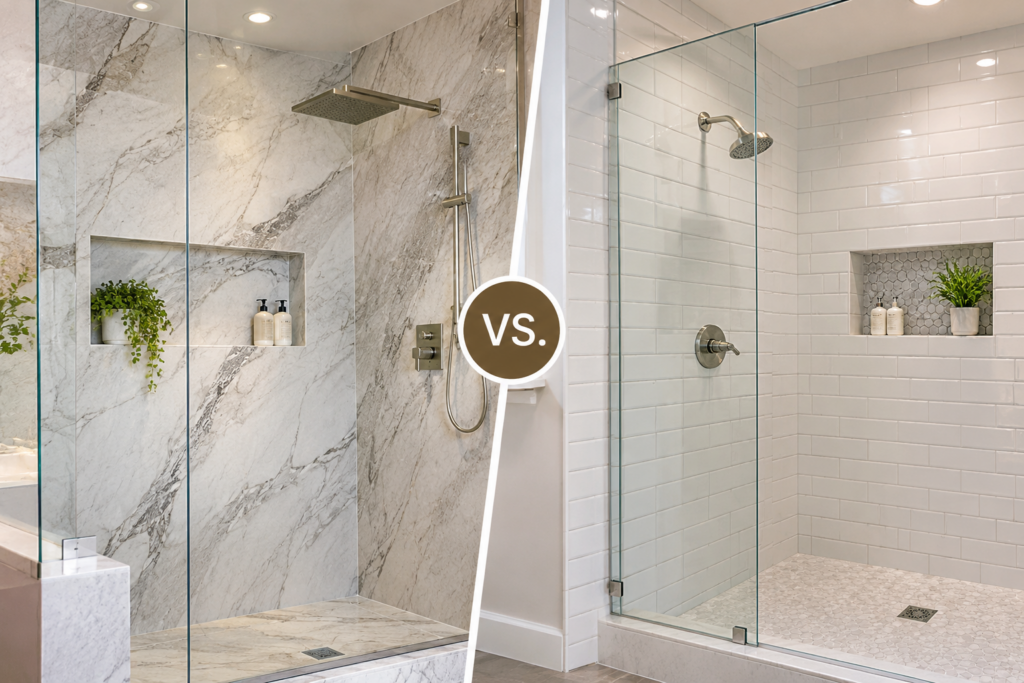
Large format shower slabs are an increasingly attractive design option for homeowners who want bathroom walls with fewer visible joints, beautiful stone patterns, and a clean, contemporary appearance. However, traditional shower tile remains a versatile choice, offering a wide variety of colors, shapes, textures, and decorative layouts.
When planning a shower remodel, choosing between large slabs and tile involves more than appearance. The materials have different fabrication requirements, maintenance considerations, design possibilities, and installation needs.
At Arena Marble & Granite in Thousand Oaks, CA, we help homeowners explore premium natural and engineered stone slabs, along with tile products for bathroom projects. Our expertise focuses on material selection and custom stone fabrication rather than installation or complete bathroom renovations.
This guide explains how large format shower slabs compare with tile so you can evaluate the right materials for your design preferences and everyday routine.
Planning a recessed niche or built-in bench as part of your shower design? Explore our shower niche and bench ideas to learn how stone selection, edge profiles, and custom fabrication details can complement your bathroom project.
Large Format Shower Slabs vs. Tile: Understanding the Differences
A shower slab is a large panel of natural stone, engineered stone, or another suitable surface material intended for a specific shower application.
Depending on its dimensions and the shower layout, a slab may cover a substantial portion of a wall with relatively few joints.
Traditional shower tile consists of individual pieces arranged across the wall. These may include small mosaics, rectangular tiles, or larger porcelain and natural stone formats.
Both approaches can create beautiful bathrooms, but they offer different design experiences.
Large Shower Slabs Create a Continuous Appearance
One of the main attractions of large format shower slabs is their uninterrupted appearance.
Natural stones such as quartzite, granite, and marble can display distinctive veining across broad surfaces. When planned carefully, the patterns become an important part of the bathroom’s visual character.
Large slabs may also complement minimalist interiors where homeowners prefer fewer decorative elements and simpler wall surfaces.
However, shower dimensions, slab sizes, cutouts, and fabrication constraints determine how many separate pieces will be required.
A slab shower is not necessarily seamless. Corners, transitions, joints, and penetrations still require appropriate detailing by qualified installers.
Shower Tile Offers Greater Pattern Flexibility
Tile provides a different kind of design freedom.
Homeowners can choose decorative mosaics, vertically stacked rectangular tiles, geometric arrangements, or combinations of different colors and finishes.
Tile can also be useful for smaller architectural details and surfaces where the design calls for multiple individual pieces.
Large-format porcelain tile offers a middle ground between small decorative tile and full-size slab panels.
At Arena Marble & Granite, we sell porcelain, ceramic, natural stone, and glass tile products. Our team can help customers explore available materials, but we do not provide tile installation.
Comparing Grout Lines, Cleaning, and Maintenance
Maintenance is one of the most common reasons homeowners compare slab shower walls with traditional tile.
Both options require regular cleaning, but the number of joints and the selected surface material can influence the routine.
Do Large Slabs Have Fewer Grout Lines?
Generally, yes. A large slab can cover more wall area than small-format tile, reducing the number of joints across the finished surface.
This can create a simpler visual appearance and reduce the amount of grout requiring routine cleaning.
However, fewer joints do not mean that cleaning is unnecessary or that the entire shower becomes maintenance-free.
Water spots, soap residue, and mineral deposits can still develop on stone or porcelain surfaces.
It is also important to distinguish between grout joints and the sealing or movement joints required in a properly constructed shower.
Does Tile Require More Cleaning?
Tile maintenance depends on the tile material, grout type, surface texture, and shower conditions.
Small-format tiles generally create more grout lines than large panels, which can mean more joint surfaces to clean.
However, porcelain tile is often straightforward to maintain, and properly selected grout products can provide good performance when cared for according to their specifications.
Natural stone tile may require additional attention because some materials are porous or sensitive to acidic cleaning products.
Rather than assuming all tile is difficult to maintain, consider the specific products and their care requirements.
Natural Stone and Porcelain Have Different Maintenance Needs
A marble slab and a porcelain slab may look similar in photographs, but their care requirements can be very different.
Marble, travertine, and limestone are sensitive to acidic substances and may require sealing and careful cleaning.
Granite and quartzite have different characteristics, with sealing needs that vary depending on the selected stone.
Soapstone generally does not require sealing, although it may develop scratches and a natural patina.
Porcelain is known for low water absorption and does not require periodic sealing.
For more information about comparing these materials, read our guide to the best stone slabs for shower walls. It explains eight material options and their maintenance considerations.
Which Option Works Better for Your Shower Design?
Neither slabs nor tile is automatically the best choice for every bathroom.
The right approach depends on the size of the shower, the desired appearance, the selected materials, and the design details.
Consider the Shower’s Dimensions
Large slabs can be visually striking on expansive shower walls, but the available panel dimensions must be considered.
Door openings, windows, recessed niches, plumbing penetrations, and benches can influence fabrication requirements.
Smaller or unusually shaped shower spaces may need multiple stone pieces or a combination of materials.
Tile offers more flexibility for certain detailed arrangements, although the specific installation requirements still depend on the product.
Decide Whether You Prefer Veining or Decorative Patterns
Homeowners who appreciate the natural movement of stone may prefer large slabs that showcase the material’s full appearance.
Quartzite and marble can create dramatic visual effects with distinctive natural veining.
For homeowners who prefer decorative arrangements, tile provides opportunities for contrasting colors, mosaics, and patterned accent areas.
Both approaches can complement warm, contemporary bathrooms or more traditional interiors.
Think About Shower Niches and Benches
Shower niches and benches introduce additional design considerations.
Some homeowners prefer to coordinate these features with the main shower wall material, while others use contrasting tile for a decorative effect.
Stone slabs can be considered for niche surrounds, shelves, and bench surfaces when the selected material and design are suitable.
These features require careful planning of dimensions, edges, water drainage, and fabrication specifications.
Arena Marble & Granite can discuss custom stone fabrication options for slab-based shower features. Waterproofing, structural work, drainage, and installation must be handled by qualified professionals.
Remember That Shower Floors Have Different Requirements
A material suitable for shower walls is not automatically suitable for shower floors.
Shower flooring requires separate consideration of slip resistance, drainage, surface finish, and manufacturer-approved applications.
For example, a highly polished slab may offer the appearance you want on a wall but may not be appropriate for a wet walking surface.
Always discuss shower floor requirements with the qualified professionals responsible for the project.
Planning Shower Slab or Tile Materials in Thousand Oaks
Before purchasing materials, gather the information that will help you compare suitable products.
Useful details include approximate shower wall dimensions, photographs of the existing space, your preferred colors, and any planned niches or bench features.
Also consider which surfaces will use slab material and which may use tile.
For large natural stone panels, examining the full slab is particularly important. Natural veining, mineral patterns, and color variation may not be obvious in small samples.
At Arena Marble & Granite, we help customers review available materials, slab dimensions, surface finishes, and custom fabrication possibilities.
Visit our Shower Remodel materials page to explore our specialized stone slab offerings.
Our team can assist with natural and engineered stone selection for shower walls, niches, benches, and other suitable slab-based bathroom improvements.
We do not provide slab installation, tile installation, plumbing, waterproofing, fixture installation, or complete bathroom remodeling services.
We welcome homeowners, designers, and contractors from Thousand Oaks, Westlake Village, Newbury Park, Oak Park, Camarillo, and surrounding communities.
Frequently Asked Questions About Large Format Shower Slabs
Are large format shower slabs better than tile?
Neither option is universally better. Large slabs offer fewer visible joints and a continuous appearance, while tile provides greater flexibility in decorative layouts, patterns, and individual piece sizes. The best choice depends on your bathroom design and maintenance preferences.
Are slab shower walls easier to clean?
Large slabs usually have fewer grout joints than small-format tile, which can reduce the number of grout lines requiring routine cleaning. However, the overall maintenance routine depends on the selected material, surface finish, and shower conditions.
Do shower slabs eliminate the need for grout?
No. Large panels reduce the number of joints, but appropriate joints and transitions are still necessary. Their construction must follow the material manufacturer’s requirements and the specifications of the shower system.
Can natural stone slabs be used for shower walls?
Yes, suitable natural stones such as quartzite, granite, marble, travertine, soapstone, and limestone may be considered for shower walls. The specific stone’s suitability, porosity, finish, and maintenance requirements should be reviewed before purchase.
Are porcelain slabs suitable for shower walls?
Porcelain slabs can be an excellent option when the selected product is approved for the intended shower application. They generally offer low water absorption, stain resistance, and straightforward maintenance.
Does a shower slab replace waterproofing?
No. A slab is a surface material and does not replace the waterproofing system required behind the finished shower walls. Waterproofing must be planned and completed by qualified professionals.
Does Arena Marble & Granite install shower slabs or tile?
No. Arena Marble & Granite supplies natural and engineered stone slabs, sells tile products, and offers custom stone fabrication for suitable shower projects. We do not provide slab or tile installation services.
Explore Shower Slabs and Tile at Arena Marble & Granite
Choosing between large format shower slabs and traditional tile begins with understanding your design goals, the available materials, and their maintenance requirements.
Whether you want the continuous appearance of natural stone or the decorative versatility of tile, our team can help you explore suitable materials for your bathroom project.
Visit Arena Marble & Granite in Thousand Oaks to compare available full stone slabs and discuss custom fabrication options.
Arena Marble & Granite
2300 Corporate Center Drive
Thousand Oaks, CA 91320
Phone: (805) 375-2771
Website: https://arenamarble.com/
Find our showroom on Google Maps.
Ready to explore your shower materials? Contact Arena Marble & Granite to request a free estimate or visit our Thousand Oaks showroom to compare premium stone slabs and tile products.